This turned out to be a long post, addressing a multitude of issues. I will be posting one section each day until the whole post is up. Your comments on each section are appreciated and welcomed…
It’s been over a year since Jack’s gone missing. Unfortunately, the Where Is Jack? Inc. team has been made aware of or been involved with several cases of animals being lost at airports during the last 15 months: Jack, of course; George in Canada; Wenty at SeaTac; Nahla at LaGuardia (RIP); Clara/Tosha at JFK; and now, Xiaohwa – and that’s not all of them. We had already learned so much, but the lessons that Xioahwa is teaching us may be the most difficult – and the most important.
LESSON 1: EARLY INTERVENTION IS OF UTMOST IMPORTANCE.
We didn’t find out Xiaohwa was missing until she had been gone for a week. A week is a long time when an animal is lost. If the animal is lost outside, they can travel a LONG WAY in a week. If they are lost inside, they will have had time to find the most hidden space, away from noise – and people. It is still possible to find a pet that has been lost for a week, but every day a pet is lost, makes it increasingly more difficult to find that pet – or even to know where to look.
This highlights a particular problem that occurs when a pet is lost in an airport or during air travel – WHAT SHOULD A PET GUARDIAN DO?? The pet guardian is away from their home, in an environment that is at least somewhat unfamiliar, and they have no authority to move around the airport freely. Many times, they are scheduled to get on a flight. Most pet guardians have no idea what to do when their pet goes missing. They feel they are left to rely on either the airline or the airport authority.
When Jack went missing Karen texted me immediately. The airline had told her Jack had been lost, but to get on the plane and they would find him. She was already in stressful situation – this was the last step in moving 3000 miles away – but when AA lost Jack, she found herself in a dramatically more tense situation. And with absolutely no idea what to do to move forward.
And quite honestly, when she texted me, I had no idea what to do, either. I was walking my dog, and on the way home it hit me – FACEBOOK. I began to work the social network to look for help. And so the movement was born…
But honestly, it wasn’t the most effective strategy for finding Jack. It didn’t get Jack found any sooner. And ultimately, because he was without food or water for 61 days, it didn’t keep him alive.
And even more importantly, we have not been able to keep other animals from being lost. Nor have we been able to create a clear path for people to follow when their pets are lost in an airport (or on a plane).
Just as when Jack was lost, the distraught pet parent is still told by the airlines that “they will find the pet” as they are boarded on the plane. Or the TSA flatly states that it isn’t their problem – leaving the guardian in an even more difficult situation.
But the true bottom line is this: no one working for any airline, in any airport, is truly charged with responding to the emergency situation that is created when a pet is lost. THERE ARE NO TRUE FIRST RESPONDERS.
And we have not yet been able to change this.
Part II: The Lessons of Xiaohwa – Losing a Pet in an Airport is Not Much Different than Losing a Pet in the Grand Canyon… will be posted tomorrow.
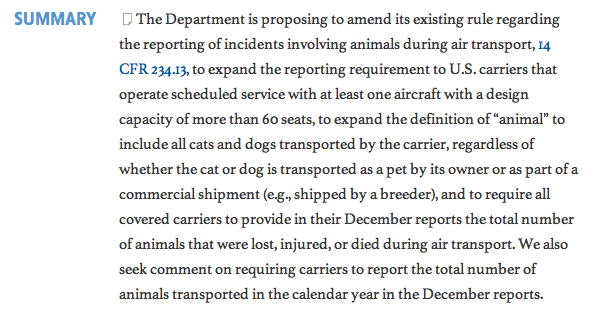
In late June, the U.S. Department of Transportation sent out a “Notice of Proposed Rulemaking” – in essence, they were asking the public to comment on a change they (the DoT) was considering making in how “Pet Air Incidents” would be reported. Here is what they were thinking about doing:
Seems pretty straightforward, right? Well, in looking back at the comments from when the rule was originally made, we knew it wouldn’t be. So we got to work drafting a LOOOOOOONNG and fairly complicated document that would try to counter all the arguments that we thought the airlines, commercial breeders, and others who would not want to see this rule would come up with. In its final form, the document is 89 pages!! (This includes a listing of every incident that has been reported since 2005.). If you’d like to read the whole thing, you can do that HERE.
But to make this a little easier, I’m posting the section titled “Discussion and Recommendations” for you to read here. It sums up the main points we made pretty nicely. Your thoughts and comments are, of course, always welcome!! Enjoy!!!
Discussions and Recommendations
WHERE IS JACK? INC. supports the three amendments to 14 CFR 234.13 as proposed by the Department of Transportation and recommends that they be adopted immediately. All animals that travel by air must be counted equally. In addition, we would also recommend the Department of Transportation consider two additional amendments to the proposed rule to more completely fulfill PL 106-181, Section 710: §41721(b), which states, “The Secretary shall work with air carriers to improve the training of employees with respect to the air transport of animals and the notification of passengers of the conditions under which the air transport of animals is conducted.”
FIRST, we ask that the Department require air carriers to follow-up and report on all incidents if they are not resolved at the time of the original filing, providing follow-up reporting for up to one year or until the incident is resolved (whichever time is shorter).
SECOND, we ask that the Department require airlines to use the information they have already collected in their incident reports to identify and implement preventative measures that can be put into place to guarantee safe travel for all animals.
That said, we do recognize that air carriers are in a difficult position in responding to these requirements, and feel that some discussion is warranted.
Americans are now guardians to 78.2 million dogs and 86.4 million cats; almost two-thirds of U.S. households have at least one dog or one cat, and many have more than one pet, or even one or more of each species. Americans spend – literally – hundreds of millions of dollars per year on their pets, and increasingly, more and more pet owners view their dogs and cats as dependents, in much the same way they view or have viewed their human children.
While people who view pets as “just animals” may not understand how a person could equate their dog or cat with a child, science is consistently finding that animals are not only sentient beings – having the ability to be conscious and perceive specific situations with their own perspective – they are also both cognitively and socially intelligent as well. Like human toddlers, most dogs (and many cats) learn to associate words with specific objects, and respond to their guardians’ moods and feelings. They seek to run from situations that scare them, and they respond positively to other creatures who are inviting. This combination of sentience, cognitive ability and social adaptability is what makes domestic animals different from their wild counterparts, and why humans have chosen to incorporate these creatures into their lives.
Our growing knowledge about the richness of the lives of dogs, cats, and other domesticated creatures stands in stark contrast to a system where animals are treated as property to be bought and sold and are shipped by air with little regard for their travel experience in the cargo hold of a plane. Many commercial breeders (most commonly of dogs, but also of cats) regard their “product” – puppies or kittens – in the same way another businessperson would regard their product – such as electronics or widgets or beer mugs. Like all “manufacturers,” commercial breeders are resigned to the fact that some “product” will be broken, lost, or even stolen while being shipped – and a certain amount of “loss” is considered acceptable. But in its very nature as a living creature, a “broken” or “lost” animal is not the same as a crushed iPad. For many people, and for all those in the animal care advocate community, a dog who emerges from a flight overheated and dehydrated is not just “unsalable” – it is a sick, helpless creature who is suffering because of the conditions created by the actions (or inactions) of humans. The same is true for all animals who have been transported – from primates to parakeets. For many animal care advocates, it is particularly disturbing to learn that most of the errors that lead to “incidents” are both anticipatable and preventable, yet none of the responsible parties chose to act in the best interests of the animal.
The 14 CFR 234.13 regulations in their current form took the pressure off airlines by relieving them of the responsibility to report on the commercial dog and cat trade, and only making them responsible to report on pets travelling with their guardians. This was the best outcome that air carriers – and commercial breeders – could have hoped for. Air carriers felt they should not be held responsible for the assumed inevitable injuries and deaths of the large number of commercially-salable dogs and cats that they would be transporting for delivery to pet stores and private individuals – animals who may already have serious health problems even before boarding a plane. Commercial breeders certainly did not want the purchasing public to have access to how many of those “cute puppies and kitties” playing in the pet store windows had littermates who had died or were lost or injured en route. The regulations in their current form allow the commercial breeder system to be maintained – without any reference to the price paid by the animals. Unfortunately, occasionally (and if we are to believe the reports, “occasionally” means about every 10 days) – the price was also paid by pets already integrated into a family when air carriers’ less than careful practices and procedures caused them to be lost, injured or die.
Adoption of the proposed amendments to 14 CFR 234.13 is likely to place the workings of the commercial dog and cat trade squarely in the public eye. Strong opposition from the ATA, airlines, breeders, and the AKC itself is likely to be heard. All of these entities have a great deal of money at stake in this issue and may not see the safe and comfortable care of travelling animals as their highest priority.
But knowing that the amended regulations may negatively impact the finances of breeders, carriers and registries is not actually relevant to the bottom-line intention of the original legislation. These regulations are designed to provide information to the public regarding the safety of animals when those animals are travelling by air.
If an air carrier accepts an animal that is not fit to fly, just as that carrier is willing to take the fee for the transport, so too must the carrier be willing to accept the responsibility for participating in the injury, death or possible loss of the animal.
Indeed, air carriers are in no way obligated to accept that responsibility. In December 2011, the Reno Gazette-Journal carried the story of Lynn Jones, a baggage handler employed by Airport Terminal Services, who had been fired for refusing to load a dog that was described as “… emaciated … paws bloody … body covered with sores” onto an aircraft.
As the newspaper reported:
Jones said her supervisor told her to load the dog on the plane because the animal’s paperwork was in order and its condition wasn’t her concern. She said she was warned she would lose her job if she kept carrying on about the dog. … Jones said she was fired from her job on the spot.
The story received national attention and Jones was eventually re-hired. This story highlights the many pressures airlines face as they are asked to account for the animals in their care.
Most baggage handling is not performed by actual airline employees. Companies like Airport Terminal Services, Swissport, and a host of others compete to provide this service – at the lowest cost possible to the airline. If their actions – such as holding a dog back from flying – consistently cost the airline money, renewal of the contract may be in jeopardy. In addition, in many large-city locations, baggage handlers are often immigrants who may have a different view of animals (and particularly dogs and cats) than many middle-class Americans have. A baggage handler having different cultural values and beliefs about companion animals may have seen what Ms. Jones saw, but not have seen it as a problem, and might have loaded the animal on the plane. The dog may have then died in flight.
The airlines are likely to resist expansion of reporting regulations because of concerns about circumstances like these – and the effort that correcting these conditions might entail. Ultimately, though, it is the responsibility of the carrier to make clear to anyone loading animals on to their planes that the safety of the animal must come first. Just as an airline is responsible to make clear to sub-contracted mechanics that the most important thing is that the plane is able to operate safely, the carrier must also make the safety standard for pets crystal clear to all relevant sub-contractors and employees. There is now a substantial portion of the American public that does not support the callous and inhumane treatment of pets, and wishes to make decisions to support or avoid particular companies with this information in mind.
The public’s right to know about the safety of animals travelling by air should not be compromised by the commercial needs of airlines, breeders, and registries. All animal care advocates do not require that commercial breeding and transport be halted, but there is an ever-growing segment of the American citizenry that is saying that safe and humane transport of animals is not only possible, but must be required. Full and transparent reporting of the outcome of animal transport by the airlines is an absolutely necessary component of that mandate, and we support all efforts by the Department of Transportation to require all parties involved in transporting animals to take this work very seriously.
Yesterday, I wrote a post about a woman who was suing Delta Airlines in the aftermath of a debacle… she had used their Pets First service to have 11 French Bulldogs flown to her in Utah from Hungary. The adult dog arrived deceased at SLC; the 10 puppies were ill and 2 died sometime soon after. The woman, Barbara Burgett, is now suing Delta Airlines and its subcontractors; her suit does not name any specific charges, but on her blog (Dogs vs. Delta) she suggests that several different laws concerning the proper treatment of animals in transit were violated.
I wrote the post after speaking with Barbara personally for about an hour. She seems like a nice lady – mother, grandmother, says she gives to Best Friends (in southern Utah) and has rescued many animals. She said she and her family were planning to “lightly” breed the dogs. I took her at her word, even though – as someone who is concerned about how many animals we euthanize in the U.S. every year – I’m not a big fan of many of the people who breed dogs. I do believe in “breed preservation” – but frankly, from what I understand, if you’re interested in preserving a particular breed of dog, you already own that dog and have been participating in breed-specific activities (e.g., dog shows, agility, etc.) long before you decide to breed. I’m not sure that was her situation. But that was a tangent… What was clear was that no matter why they were coming to the U.S., these dogs did deserve to be treated well on their way here – they did not deserve to die of heat stroke on the flight. Or to become seriously ill because of their time on the plane.
After I posted this piece, and shared it with the Jack page on facebook, I was surprised at the response. Many people questioned the truth of the story… FoJ Cara Jordan put her concerns the most clearly: ” Can we remove this story until more facts are received. its extremely vague and really, with everything going on regarding Jack, I’d be super careful of putting other unsubstantiated cases [before] us! My family have used delta for some time, and I have NEVER had a problem. Although I think problems can and DO happen, this story is far fetched and I’d hate for this wonderful site to forego any repercussions for posting such an unbelieveable story!”
I obtained copies of the documents Ms. Burgett filed with the court, as well as responses from Delta and the other defendants. No one asked the court to dismiss the case – which is what they would have done if there were any question about the basic facts. So I feel confident asserting that this isn’t just some lady in Utah making libelous statements against Delta.
But… even though I am confident in saying that based on what I know about this situation, Delta clearly did not treat these dogs as “precious cargo,” I am still not completely comfortable with this case. Why? Because there was a problem even before these dogs were ever put on the plane.
Here’s the premise on which the whole story rests: Barbara Burgett was BUYING these dogs. They were to become her PROPERTY – their ownership was to be transferred to her because she was willing to pay for them. It seems she was willing to pay alot of money for them – something around $20,000. And she was buying them from someone who clearly made it his BUSINESS to buy and sell dogs!! She says on her blog, Dogs vs. Delta:
Prior to purchasing the dogs, I took the following responsible steps and precautions. I contacted the American Embassy and had them do a back ground check on the person selling them, and to help in finding an interpreter. The background check was clean, and there were no complaints or legal actions of any kind against them. After deciding on an interpreter, I then contacted several veterinary hospitals in their area to inquire about them from the vets perspective (dog care practices etc), and none of these places had any complaints or knew of any complaints. I then contacted four people in the USA that had purchased dogs from this person, and they all said there dogs were healthy and great, and had also arrived healthy. I traveled to see a son of Hector’s, he was beautiful too and the owner had no complaints about this seller either. So, I proceeded forward and over the next six weeks, made arrangements to purchase my dream dogs.
So here we have a situation where one person (in Hungary) who views dogs as mere property to be bought and sold (and has been doing this for some time) is now SELLING the dogs to another person who also views these dogs asproperty to be bought and sold… and then, of course, Delta is going on to treat the DOGS AS PROPERTY because airline cargo, is by definition, property. Cargo is not passengers.
And the saddest thing is, ALL ELEVEN OF THE DOGS PAID A STEEP PRICE because they were viewed as property. Three paid with their lives.
Barbara Burgett says on her blog, “I know that no one that has a love of animals/dogs would ever attempt to make this incident about where the dogs came from, or, how much they cost…”. Indeed, why would it be necessary to make an issue of their origin if they were treated with the care and respect they deserved from the beginning? Who cares where a loving creature comes from?? I have many friends who have adopted children from other lands – China, Peru, Slovakia. Adopting a child from another country is an expensive proposition – I’ve heard of people spending upwards of $50,000 to adopt, including travel expenses. But it’s about LOVE… and that is reflected in their behavior, not in the money spent!!! IN NO CASE have I ever heard of a child being put on a plane from that other county and flown to the U.S. alone. The new parents – the people who have made a commitment to care for this little bundle of love for its lifetime – go to the new country and meet the child and bring him or her to their home.
Of course, no one would go to such lengths to obtain a purse they saw on the web that they thought was really spectacular. They’d just have it shipped.
And that is what Barbara Burgett did. And that is what the seller of the dogs allowed.
Because both of them saw the dogs as property. Not as sentient beings who deserve respect and appropriate care in every moment of their lives.
Barbara says she was willing to pay a vet tech to fly with the dogs, but that wouldn’t have gotten them out of cargo. Why wasn’t she willing to fly herself to go get the dogs? Or fly with 10 family members to go get the dogs? Or even just fly 11 Hungarian vet techs – one with each dog – to Utah to bring the dogs to her?
Barbara says she loves her dogs. And I believe she does. But… but but but. The fact that she was willing to BUY them – and to then use them to breed, and I assume make at least some money from them – means that she does, on some level, see them as her property to do with as she pleases. The shipping is just an incidental outgrowth of the belief that the dogs are property.
Her thinking is not unusual. It is THE NORM. In fact, it is the basis of how animals are treated in the U.S. legal system.
But this thinking does not respect the animal as a conscious creature with its own thoughts and feelings, and which has the right not to suffer needlessly . That is the definition of a “sentient being.”
For me, treating our animals with respect as the sentient beings they are comes down to acting within a simple basic principle – if I wouldn’t allow a toddler to have a particular experience (e.g., flying in cargo), I wouldn’t let my dog or cat have that experience.
But what about Jack, you say… Karen didn’t follow that principle. She let Jack and Barry fly in cargo (even though Jack didn’t make it that far).
True enough. Karen made a HUGE mistake – one that can’t be taken back. And one that she will never make again. But it was just that – a mistake. It was not a mistake on top of a mistake… like the one Barbara Burgett made. And if Ms. Burgett is breeding these pups (who are now 4 years old), I would argue she is piling mistake on top of mistake on top of mistake. All because of the belief that animals, at base, are property.
Until we change our thinking about dogs – and cats, and all of our companion animals – situations like this are going to keep happening. There will be a hundred thousand more “breeder dogs” killed on planes without our knowledge. A thousand more Jacks will be lost in airports, the search for them minimal if it happens at all. Countless Toshas and Nahlas will bolt from their crates – some will be lucky and be found safely, others won’t.
So I send love and light out to Hector and the pups who died, and to the 8 survivors… yes, you were treated wrongly in your journey. But, my dear little furry friends, there were problems before you ever got on that plane…





 Where is Jack?